

| Fidelity Inst MM Port Inst (FNSXX) | 0.25 |
| Touchstone Institutional MMF (TINXX) | 0.24 |
| Fidelity Inst MM Port I (FMPXX) | 0.21 |
| Highmark Diver MMF Fid (HMDXX) | 0.20 |
| DWS Daily Assets Instit (DAFXX) | 0.19 |
| Dreyfus Money Market MM (DMIXX) | 0.10 |
| Fidelity Select MM Portfolio (FSLXX) | 0.10 |
| Schwab Cash Reserves (SWSXX) | 0.08 |
| Highmark Diversif MMF Ret (HMVXX) | 0.07 |
| Western Asset Money Mkt A (SBCXX) | 0.07 |
| Marshall Tax-Free MMF I (MFIXX) | 0.47 |
| Marshall Tax-Free MMF Y (MTFXX) | 0.22 |
| Ridgeworth Inst Muni Cash I (CMRXX) | 0.19 |
| Federated Muni Obligs IS (MOFXX) | 0.14 |
| Federated NY Muni Cash IS (NISXX) | 0.14 |
The Federal Reserve's latest "Flow of Funds" Z.1. Statistical Release shows that nonfinancial corporate businesses became the second-largest holder of money market mutual funds (behind the household sector) in the fourth quarter of 2009. Since 2007, funding corporations, which includes securities lenders, had been the second largest holder of money funds. The Fed's "Flow of Funds" contains a wealth of statistics on U.S. finances, including several tables on money market mutual funds.
The Fed's Table L.206 "Money Market Mutual Fund Shares shows the Household sector with $1,320 billion, or 40.5% of the $3.259 trillion as of Q4 2009. Nonfinancial corporate businesses held $684 billion, or 21.0%, while Funding corporations held $669 billion, or 20.5%. Life insurance companies ranked a distant fourth with $246 billion, or 7.5% of money fund assets. Other money fund holder categories include: Private pension funds ($96 billion, or 3.0%); State and local governments ($92 billion, or 2.8%); Nonfarm noncorporate businesses ($74 billion, or 2.3%); Rest of the world ($59 billion, or 1.8%); and State and local government retirement funds ($19 billion, or 0.6%).
During the Fourth Quarter of 2009, Funding corporations saw the largest decline in assets (down $50 billion), followed by Households (down $28 billion), Nonfinancial corporate businesses (down $16 billion) and Life insurance companies (down $11 billion). During 2009, Household holdings of money funds declined by $260 billion (-16.5%) and Funding corporation holdings declined by $175 billion (-20.8%), while Nonfinancial corporate business declined by just 7.0% (-$52 billion).
The Fed's Table L.121 "Money Market Mutual Funds" shows that Time and savings deposits represent the largest holding of money market funds with $573 billion (17.6%) as of Q4 2009. Agency- and GSE-backed securities rank second, according to the Z.1 "Flow of Funds," with $543 billion (16.7%), while Open market paper (which includes CP) accounts for $511 billion (15.7%). Security RPs (repo) ranks fourth with $480 billion (14.7%), Treasury securities rank fifth with $406 billion (12.5%), and Municipal securities rank sixth with $401 billion (12.3%). The remainder of money fund assets is invested in Corporate and foreign bonds ($170 billion, or 5.2%), Foreign deposits ($97 billion, or 3.0%), Miscellaneous assets ($59 billion, or 1.8%), and Checkable deposits and currency ($18 billion, or 0.5%).
The biggest increase in holdings over the past year was in Time and savings deposits, which rose by $218 billion (61.4%). Agencies, Treasuries, and CP all saw sharp declines in 2009, down $213 billion (28.2%), $171 billion (29.7%), and $108 billion (17.4%), respectively. To request a copy of a spreadsheet version of these money fund tables, e-mail info@cranedata.us.
In a just-published "Credit FAQ piece, "What Effect Will The Certificate Of Deposit Accounts Registry Service Program Have On Fund Ratings?, S&P writes, "The recent market turmoil has prompted portfolio managers, investment managers, and treasury professionals to look for investments that add value without sacrificing yield or diversification. Recently, Standard & Poor's Ratings Services has received numerous inquiries regarding how we view the liquidity and credit quality of the Certificate of Deposit Accounts Registry Service (CDARS) program in regards to principal stability fund ratings (PSFRs), fund credit quality ratings (FCRs), and liquidity assessments."
The FAQ explains, "We have criteria regarding our assessment of certificates of deposit (CDs) and collateralized CDs for taxable and tax-exempt PSFRs, FCRs, and liquidity assessments.... Our responses to the following questions provide an indication of how we assess the risks of these securities in relation to our analysis of PSFRs, FCRs, and liquidity assessments. This Credit FAQ should be considered in conjunction with previously published criteria."
Among the Frequently Asked Questions are: "What is the CDARS program?" S&P says, "CDARS is a program offered by nearly 3,000 member financial institutions of the CDARS network and is designed to provide investors the benefit of Federal Deposit Insurance Corp. (FDIC) insurance for deposits up to $50 million. Generally, investors place large deposits with a member, who then places the investors' deposits into CDs issued by participating banks. CDs issued through CDARS generally are in amounts less than the FDIC insurance maximum so that each CD's principal and interest remains eligible for full FDIC insurance. Currently the FDIC insurance maximum is $250,000 per depositor through Dec. 31, 2013. After the extension date, the maximum amount is scheduled to return to $100,000 per depositor.... CDARS CDs' maturities generally range from four weeks to five years.... Typically, early breakage penalties exist and generally vary based on the CD's maturity."
They also ask, "How does Standard & Poor's treat noncollateralized CDs compared to CDARS CDs?" S&P answers, "In PSFRs and FCRs, noncollateralized CDs that do not qualify for FDIC insurance take on the same credit rating as was assigned to the issuing bank. Portfolio exposures no greater than 5% per issuing bank are consistent with our investment-grade PSFR criteria.... For both PSFRs and FCRs, to the extent the underlying deposits fall within FDIC coverage amounts, we classify CDARS equivalent to the U.S. sovereign credit rating. How does Standard & Poor's view the credit risk associated with CDs issued by CDARS? In our opinion, because CDARS-issued CDs are FDIC insured, we view the credit risk as equal to the U.S. government sovereign credit rating (currently 'AAA')."
Another question is, "How does Standard & Poor's view the liquidity risks associated with CDARS CDs?" S&P says, "In our opinion, potential areas of liquidity risk in CDARS CDs include: Inherent illiquidity: CDARS CDs are nonnegotiable, not DTC eligible, and are not traded in an active secondary market; Payment delays: When the FDIC has to make a payment on deposits, it pays the insured amount to the participating bank, and the participating bank pays the investors; Custodian bank failure: Another potential liquidity risk may occur where the investor's money is in the custody of a network member that has failed."
They also ask, "What other concerns does Standard & Poor's have regarding CDARS CDs?" The FAQ responds, "Early breakage penalties: CDARS CDs can have penalties from 50% to 100% of the interest due depending on the CDs' maturity. Typically, the earlier a CDARS CD is broken prior to maturity, the greater the penalty. Because the interest penalty owed may be unearned at the time of the early breakage, the assessed penalty may result in a loss of initial principal. Coverage under relevant guidelines: The FDIC insurance limits are not based solely on the CDARS CD amount, but rather on the total aggregate exposure of an individual investor at a participating bank. We would take into account how investors determine whether their aggregate deposits (including their CDARS CD exposures) are within FDIC insurance limits and CDARS guidelines."
S&P continues, "How will Standard & Poor's evaluate CDARS CDs given your PSFR criteria? We will evaluate CDARS CDs similar to the analysis for other highly rated, short-term instruments.... From a credit perspective, we deem CDs issued through CDARS to be 'AAA/A-1+' equivalent. CDARS CDs count toward our 10% limited liquidity/illiquid basket for PSFRs because these CDs are nonmarketable securities, may impose fees for early withdrawal, and may have a delay in receiving monies from FDIC insurance payments."
Finally, they ask, "How would Standard & Poor's evaluate similar FDIC products?" S&P says, "In evaluating other similar types of FDIC products, such as the Institutional Deposits Corp.'s Insured Deposit Liquidity Account and Insured Network Deposits, we would take a similar approach in applying our criteria to assess such pooled FDIC-insured accounts." Note that Crane Data has yet to see any CDARS or "pooled FDIC insurance" products appear in money market mutual funds, but that some less-regulated pools appear to be dabbling in the sector.
MFI PDF March 2010 Issue |
Largest Money Fund Managers |
|
|
The March 2010 issue of Money Fund Intelligence features: “Final MMF Reforms Out: Funds Await Next Steps", which discusses the SEC's recent Money Market Fund Reforms; "Looking for a Legg Up: The New Western Asset", which interviews money fund veterans Kevin Kennedy and Michael Van Raaphorst; and "Quotes on the Business of Money Market Funds", which highlights a number of comments from recent webinars and conference calls. Money Fund Intelligence features news, information, and performance on money market mutual funds and other "cash" investments. Money fund statistics include: assets, average maturities, expense ratio, 7-day yield, 30-day yield, 1-month return, 3-mo, YTD, 1-year, 3-yr, 5-yr, 10-yr, and since inception returns, plus gross yields. MFI also contains tables of the top-yielding and largest money funds, as well as our benchmark Crane Money Fund Indexes. Subscriptions are $500 a year and include online access to archived issues and additional features. Bulk discounts and site licenses are available. Write info@cranedata.us or call 1-508-439-4419 to subscribe or to request more information. |
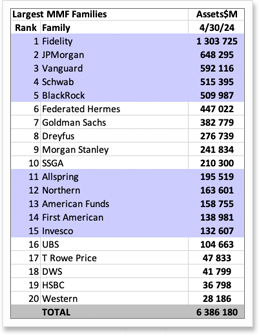
The table below is excerpted from our monthly spreadsheet product, Money Fund Intelligence XLS. It shows the largest managers of money market funds as of Feb. 28, 2010.
|
|
Crane Data LLC is a money market and mutual fund information company founded by Peter G. Crane and Shaun Cutts. We collect money market mutual fund, bank savings, and cash investment performance, statistics, and information and distribute rankings, news, and indexes.
Crane Data publishes Money Fund Intelligence, Money Fund Intelligence XLS, MFI Distribution Survey, the Crane Money Fund Indexes, and a series of products tracking money market mutual funds and cash investments. For a sample issue of MFI, e-mail sample@cranedata.us or call us at 1-508-439-4419.
ICI's latest weekly "Money Market Mutual Fund Assets shows assets falling below the $3.1 trillion level for the first time since November 2007. Yesterday afternoon's release said, "Total money market mutual fund assets decreased by $36.22 billion to $3.090 trillion for the week ended Wednesday, March 10, the Investment Company Institute reported today. Taxable government funds decreased by $18.82 billion, taxable non-government funds decreased by $12.35 billion, and tax-exempt funds decreased by $5.05 billion." Year-to-date, money fund assets have declined by $203 billion, or 6.2%, with institutional assets falling $169 billion, or 7.6%, and retail assets falling $34 billion, or 3.2%. Over 52 weeks, money fund assets have fallen a startling $816 billion, or 20.9%. (Institutional assets have fallen $485 billion, or 19.1%, and retail assets have fallen $331 billion, or 24.3%.) In other news, see "FDIC Board Approves An Extension Regarding the Safe Harbor Protection for Securitizations", which says, "The Board of Directors of the Federal Deposit Insurance Corporation (FDIC) today approved by notational vote an extension through September 30, 2010 of the Safe Harbor Protection for Treatment by the FDIC as Conservator or Receiver of Financial Assets Transferred by an Insured Depository Institution in Connection With a Securitization or Participation."
A press release posted on Nasdaq.com says, "Fitch Ratings has released a primer for investors on European Money Market Funds (MMFs) which provides clear and key insights into the EUR1.3trn sector, as well as explaining how different funds operate and the risks they present among other factors. The primer, which is presented in an easy-to-navigate question and answer format, aims to answer investors' questions about money market funds, such as who bears the risks, the differences between MMFs and other cash instruments, and which risks are embedded in such funds among other pointers. In addition, Fitch provides additional information explaining how the agency rates money market funds, and on its new MMF rating scale introduced in October 2009." Aymeric Poizot, head of Fitch Ratings EMEA Fund and Asset Manager Ratings group says, "Fitch provides MMF ratings to help investors compare between funds and distinguish between true/traditional money market funds and so-called liquidity plus or enhanced cash funds whose risk profiles may be more akin to short-term bond funds.
The more printer-friendly (62-pages) Federal Register version of the SEC's Money Market Fund Reforms was recently posted on the SEC's Final Rules web page. Also, the New York Federal Reserve, which yesterday issued its "Statement Regarding Counterparties for Reverse Repurchase Agreements," added a clarifying document, "RRP Eligibility Criteria for Money Funds: Frequently Asked Questions." A couple of the Q&A's include: "Does the $20 billion net assets requirement apply to the money fund or the fund family? The net asset requirement applies to the RRP counterparty applicant, which is the money market fund itself. As stated in the RRP Eligibility Criteria for Money Funds, to be accepted as a RRP counterparty, an applicant must, among other things, be a money market fund that satisfies the description set forth in Section I(A) and have net assets of no less than $20 billion for six consecutive months (measured at each month-end) prior to the submission of the application.... Will a seven-day put option be provided to money market funds who become RRP counterparties? Yes. As stated in footnote 4 in the RRP Eligibility Criteria for Money Funds, it is contemplated that for RRP with terms exceeding seven days, the RRP counterparty will be permitted to resell the securities to the New York Fed upon seven days prior notice. The specifics of this option will be provided in the New York Fed's Master Repurchase Agreement for money market funds, which the New York Fed expects to publish in about a month."
Brian Pringle has moved from Columbia Management to Russell Investments as a Portfolio Manager. He reports to Director of Short-Term Investments Kelly Mainelli.
Invesco Fixed Income CEO Karen Dunn Kelley will receive the Women's Bond Club's Merit Award, "presented to a senior woman leader for her career accomplishments in financial services," according to a press release. The Women's Bond Club is "the first organization in New York to focus on the advancement of women in finance."
Mary John Miller was confirmed as Assistant Secretary for Financial Markets. A release says, "Mary John Miller was confirmed today by the United States Senate to serve as the Department of the Treasury's Assistant Secretary for Financial Markets.... Miller will also ... coordinate the inter-agency President's Working Group on Financial Markets." "I am pleased to have Mary on our team and am confident she will be integral to this Administration's efforts to help maintain stability for the financial markets and finish the work of creating a safer, more stable financial system to serve the needs of American households and businesses," said Treasury Secretary Tim Geithner. Miller spent 26 years working for T. Rowe Price Group, Inc., most recently as the director of the Fixed Income Division." Miller is also a former money fund manager and advisor to the ICI's Money Market Working Group.
Crane Data's annual money fund conference, Crane's Money Fund Symposium, will be held July 26-28, 2010, at The InterContinental Boston. Visit our conference website to register or for more details.
Crane Data's new premium database product, Money Fund Wisdom, allows users to build custom queries with money fund peer groups. Wisdom offers users access to the entire suite of Money Fund Intelligence products and historical data.